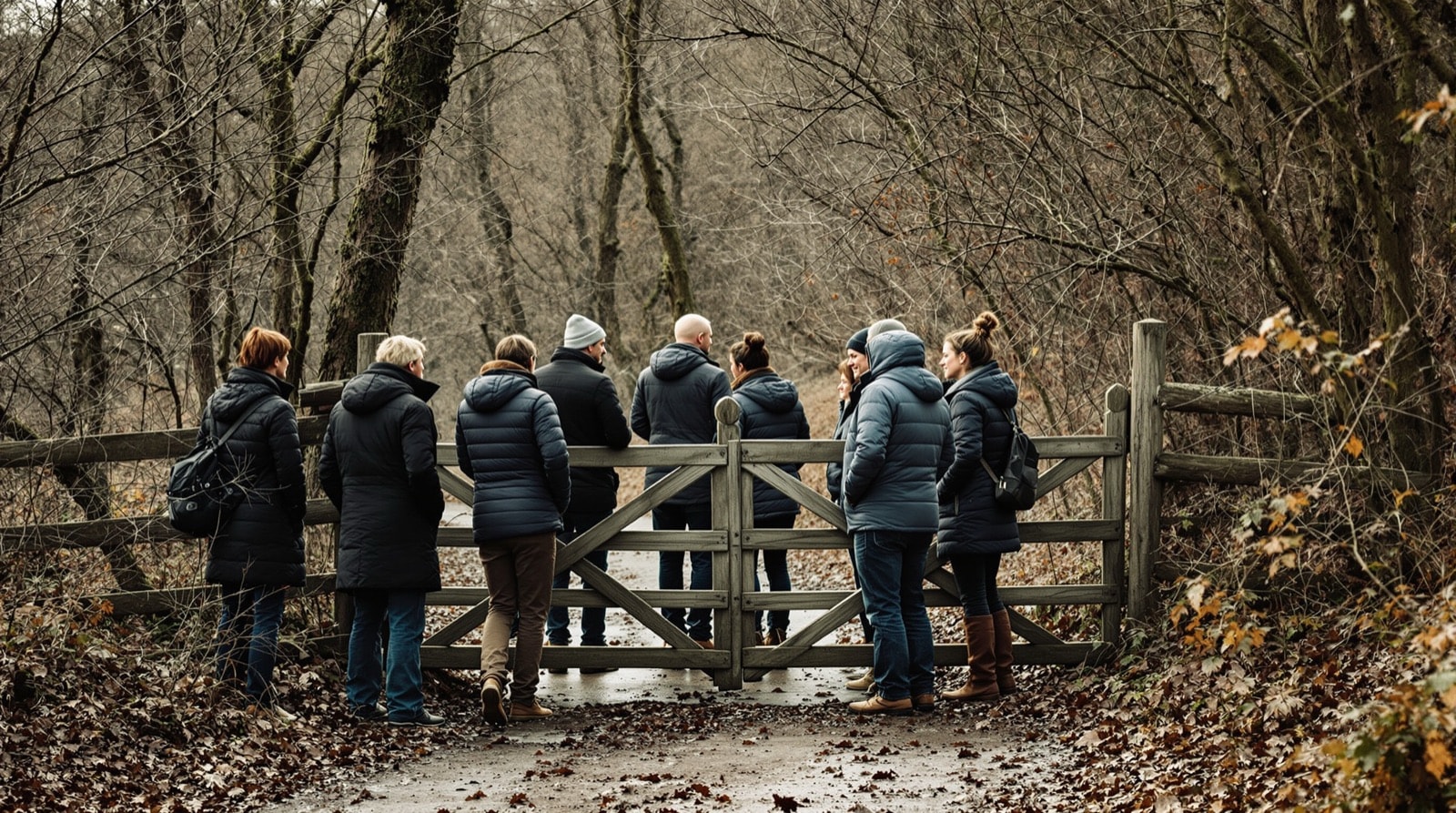
Before the start: the fifteen minutes that decide everything
People arrive early, and what happens in that window sets the tone. The meeting point should be somewhere a stranger can identify without asking — a car park, a specific gate, a bandstand — and it should be described in the joining information in plain terms rather than as a map pin alone.
Newcomers are the priority. Someone attending a netwalk for the first time is standing in a car park among people who appear to know each other, which is the same social problem as the doorway of a networking room, just outdoors. A good organiser greets arrivals individually, and has already decided who each newcomer will start walking with.
The briefing: two minutes, not ten
A short standing briefing before setting off should cover four things and nothing else:
- The route and the finish time. Distance, terrain, roughly when everyone will be back. People need to know whether they can make their next appointment.
- The format. That it is walked in pairs or threes, and that there will be a reshuffle partway. Saying this out loud gives everyone permission to change partners later without it feeling like a rejection.
- Any safety points. A road crossing, a stile, a stretch where the group needs to walk single file.
- Who to find if something goes wrong. One named person at the front, one at the back.
Long introductions in a circle before the walk are a common and avoidable mistake. They import the format that people came out to escape, and they eat the goodwill of the first fifteen minutes. Introductions belong in the walking conversations.
Pairing: the part most walks get wrong
Left alone, a group of twelve will self-organise into whatever configuration is most comfortable, which is usually the people who already know each other. That is a pleasant morning and a wasted opportunity, and it is the reason regulars quietly drift away — they have already had all of those conversations.
Two approaches work. The simplest is direct pairing: the organiser walks the group out and puts specific people together, out loud, without ceremony. It feels slightly heavy-handed the first time and is almost always welcomed, because it removes the burden of choosing. The alternative is a mechanical rule — pair with someone you have not met, or with the person whose work is least like yours — which achieves the same thing with less organiser effort and slightly less precision.
Threes are underrated and should be used deliberately when numbers are odd, when a newcomer is nervous, or when one participant is markedly quieter than the rest. The dynamic in a three is gentler than in a pair, because nobody has to carry the conversation alone.
The first leg
The opening twenty to thirty minutes are for the conversation to settle. Pace matters enormously here: the group should be moving slowly enough that the least fast walker is not working. A useful test is whether people can complete a sentence without a breath in the middle of it. If they cannot, the pace is wrong, and the pace is the organiser's responsibility rather than the participants'.
Harvard Health on building a walking habit makes the point that sustainable walking is walking that does not have to be recovered from. The same applies socially: a walk that leaves people wrung out will not become a habit.
The reshuffle
The single most valuable structural feature of the format is a deliberate change of partners partway round, and it works best when it is tied to a physical landmark rather than to a clock — a gate, a bridge, a bench, the top of a rise. Everyone gathers, there is a pause of a minute or two, and then people set off again with someone different.
Tying it to a landmark rather than a time does two things. It gives the front of the group a natural reason to stop and let the back catch up, which quietly solves the string-out problem without anyone having to be told to slow down. And it makes the change feel like part of the route rather than an intervention.
Some walks reshuffle twice on a longer route. More than twice is usually too many — each conversation needs long enough to get past the preliminaries, and twenty minutes is about the floor for that.
The second leg and the finish
The second leg is where the useful conversations tend to happen, because everyone has warmed up socially and the group has stopped worrying about the mechanics. It is also where the organiser should be doing the least.
The finish should be clean. Back at the start point, a brief thank-you, the date of the next one, and then people leave. Many walks add optional coffee afterwards, which is a good idea provided it is genuinely optional and announced as such — a mandatory-feeling social extension turns a ninety-minute commitment into a three-hour one and quietly excludes anyone with a school run.
The follow-up
What happens in the next forty-eight hours determines whether the walk produced anything. The convention that works is modest: connect with the people you actually walked with, reference something specific from the conversation, and make any introduction you offered within a couple of days or not at all. Bulk-connecting with every attendee and following up with a pitch is the fastest way to not be invited back, and it is covered in more detail in netwalking etiquette.
A worked timing
- 0:00–0:15 — arrival, individual greetings, newcomers matched.
- 0:15–0:17 — standing briefing: route, format, safety, finish time.
- 0:17–0:45 — first leg, pairs or threes, deliberate pairing.
- 0:45–0:50 — landmark stop, regroup, reshuffle.
- 0:50–1:20 — second leg with new partners.
- 1:20–1:30 — return, thank-you, next date, clean finish.
Ninety minutes, three to four kilometres, two substantial conversations per person. That is the whole machine. The rest is choosing the right route and the practicalities of running it.