The single most important criterion: width
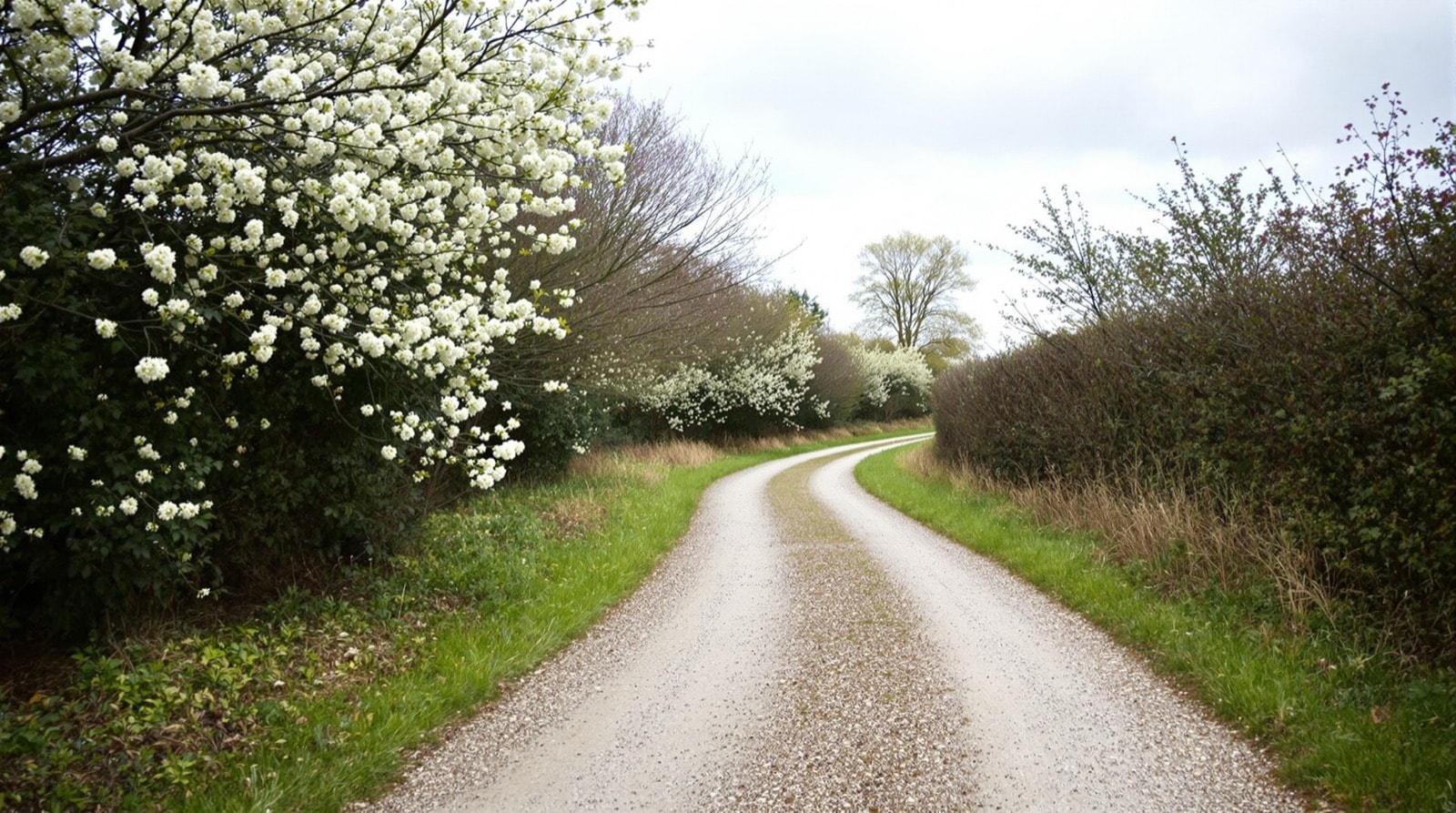
The route must be wide enough for two people to walk comfortably abreast for the great majority of its length, and ideally wide enough for three in places. This matters more than distance, scenery, gradient or anything else, because the entire format depends on people being side by side.
A narrow single-file path converts a netwalk into a queue. Conversation over a shoulder is exhausting, the group strings out, and the person at the back has nobody to talk to at all. Short single-file sections are fine and even useful — they create natural regrouping points — but a route that is single file for long stretches is simply the wrong route.
Surface and drainage
Compacted gravel, hardcore, canal towpath, disused railway line, park path and forestry track are the netwalking staples for a reason: they drain, they stay walkable in winter, and they are usually wide.
Clay field paths, ploughed headlands and heavily used bridleways behave completely differently in January from how they behave in June. A route that is delightful in summer can be genuinely unsafe underfoot after a wet autumn, and the people it hurts are the ones who came in ordinary shoes because the walk was described as easy. If you use a seasonal route, either walk it before every event or say clearly which months it runs.
Noise
Noise is the most commonly overlooked factor and it ruins walks. A path running beside a busy road makes normal conversation impossible without raising your voice, and raising your voice destroys exactly the quality that makes side-by-side conversation valuable. The same applies to routes under flight paths, alongside working sites, or beside a fast river in spate.
Test this properly: walk the route and try to hold a quiet conversation. If you find yourself repeating things, the route fails, however good it looks.
Gradient
Gentle undulation is fine and pleasant. Sustained climbs are not, because they price the conversation out. When people are working hard enough to be short of breath, they stop talking, and the strongest walkers pull away from everyone else at exactly the moment the group is least able to close the gap.
If a route has one good climb, plan the regroup at the top of it. That turns the climb from a divider into a natural pause point.
Length and time
Three to five kilometres suits a ninety-minute event with a briefing and a regroup, at a genuine conversational pace of roughly three to four kilometres per hour. That pace is slower than most planning tools assume — a route that a walking app says takes fifty minutes will take a talking group considerably longer, and building the timing off the app is how walks finish twenty-five minutes late.
Always time your own reconnaissance walk and add a margin. Then publish the finish time and hit it.
Shape: loops, out-and-backs, and why loops win
A loop returning to the start point is almost always the right choice. Everyone parks once, nobody needs a lift, and the walk has an obvious end. Out-and-back routes work but have a psychological flaw: the turnaround point makes the second half feel like a return journey rather than a continuation, and conversations tail off.
Point-to-point routes with transport at the end are a logistical burden that a monthly networking walk does not need.
Designing in the regroup
Pick the landmark for your reshuffle when you plan the route, not on the day. The best ones are unambiguous and slightly narrow — a gate, a footbridge, a bench, a junction of paths — because a slight bottleneck makes the group bunch naturally and the pause happens without anyone announcing it.
Ideally the regroup lands somewhere between forty and fifty-five per cent of the way round. Earlier and the first conversation is truncated; later and the second one is.
Access, permissions and courtesy
Most netwalks use public rights of way, park paths, permissive paths and open access land, where a modest group of adults walking quietly needs no permission. It is still worth knowing what you are walking on. The Ramblers maintain extensive resources on walking routes and access rights, and their guidance is the sensible first stop when you are unsure about the status of a path.
Some straightforward courtesies apply to any group in the countryside: walk in single file across growing crops and where paths are narrow, leave gates as you found them, keep clear of livestock, and be conspicuously polite to other path users, who did not choose to meet twelve people coming the other way. On land where an owner or ranger might reasonably want to know, a quick note in advance costs nothing and occasionally gains you a parking arrangement.
Reconnaissance
Walk any new route yourself before you use it, and walk it in conditions resembling the ones you will use it in. Check the things a map cannot show you: how wide the path really is, how loud it is, whether a stile has become impassable, whether the gate is locked, whether the car park fills up on a Thursday morning.
A checklist
- Two abreast for at least eighty per cent of the distance.
- Drains well, or explicitly seasonal.
- Quiet enough for an unraised voice throughout.
- No sustained climb — or the regroup is at the top of it.
- Three to five kilometres, timed at a talking pace, not an app pace.
- A loop back to reliable parking.
- An obvious regroup landmark near the midpoint.
- Stiles, steps, gates and likely mud all described honestly in the joining information.
- Walked in advance, in comparable conditions.
A route that satisfies that list will feel effortless to everyone who walks it, and none of them will know why. That is the job.