1. The face stops being a channel
Face-to-face conversation is a high-bandwidth, high-load exchange. Both parties are continuously reading and producing expression, and both are aware of being read. That is enormously useful when the point is to build rapport quickly, and it is a burden when the point is to think aloud. Managing your face while working out what you actually believe is genuinely hard.
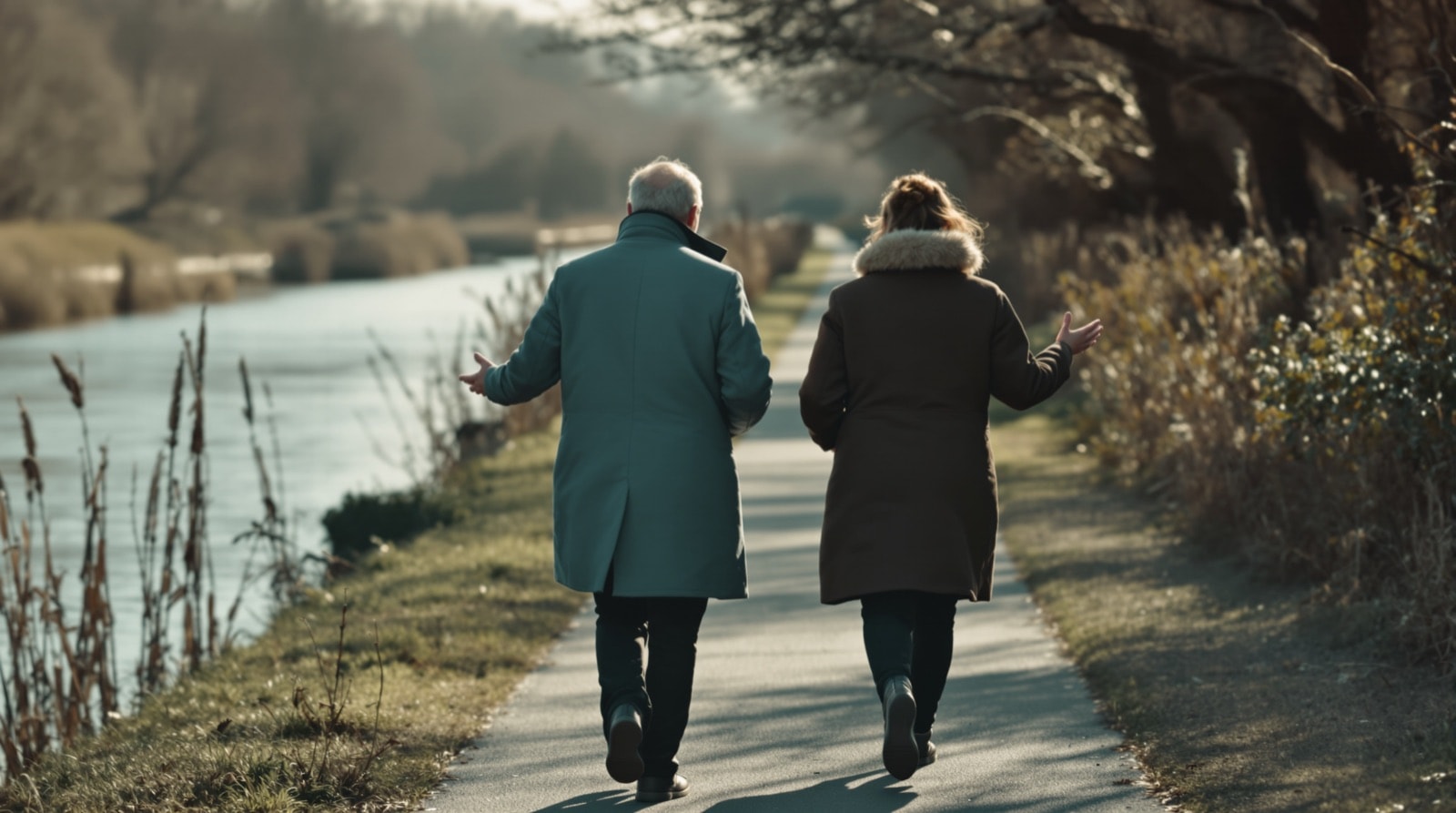
Side by side, that channel closes almost entirely. You can glance across, but the default is forward. The effect is a marked drop in self-monitoring — the same reason difficult conversations have always been easier in a car, or on a walk home, than across a desk. It is not that people become more honest exactly; it is that they become less performed.
2. Silence stops being a failure state
Across a table, three seconds of silence is a problem to be solved and somebody rushes to fill it. On a footpath, three seconds of silence is just three seconds of walking. Nobody notices, because there is an obvious shared activity underway.
This matters more than it sounds. The most useful answers in a business conversation are usually the ones that required a pause first. A format that punishes pauses systematically selects for the pre-prepared answer — the elevator pitch, the standard objection-handle, the tidy version of the problem. A format that tolerates pauses gets the untidy version, which is the one worth talking about.
3. Movement changes the thinking itself
This is the part with the strongest research behind it. In the Stanford experiments on walking and creative thinking, participants completed standard tests of idea generation while seated and while walking. Walking produced a substantial increase in divergent thinking — the ability to generate many varied ideas from a prompt — with the great majority of participants scoring higher when walking than when sitting. The effect appeared both on a treadmill indoors and, in a later experiment, walking outdoors. A residual boost persisted for a while after sitting back down.
Notably, the effect on convergent thinking — problems with a single correct answer — was much weaker. That asymmetry is the practical lesson. Walking is a thinking aid for open questions, not for closing them. "What are all the ways this could work?" belongs on a walk. "Which of these three options are we choosing, and what does it cost?" belongs at a table with the numbers in front of you.
4. The conversation has a container
Every seated networking conversation contains an unspoken negotiation: how do we end this without either of us feeling dismissed? It is a small tax, but it is levied on every single interaction, and it is why people hover at the edges of networking rooms.
A walk removes it. The conversation lasts until the gate, or until the group regroups, and then it ends for structural reasons that have nothing to do with either person's interest. Nobody has to escape. Paradoxically, that makes people more willing to commit to the conversation while it lasts, because they know its length in advance.
5. Shared direction does social work
Two people walking the same way at the same speed are, at a very basic level, cooperating. The body reads it as alliance rather than as negotiation. This is not a claim about anything mystical; it is a claim about posture and rhythm, and it is the same reason that people who row, march or dance together report feeling more affiliated afterwards.
It has a practical consequence for netwalk design. If the pace is mismatched, the effect reverses — one person is pulling and one is labouring, and the body reads that accurately too. A pace set to the slowest comfortable walker is not merely a courtesy. It is a precondition for the format working at all, which is why pace management is treated here as a core skill rather than an afterthought.
6. The setting supplies material
Conversations on foot are punctuated by things: a heron, a view, a bad gate, weather arriving. These are conversational free gifts. They reset a stalled exchange, they give an introvert something to say, and they carry no risk. Indoors, the equivalent function is served by the coffee and the room temperature, which run out quickly.
Better prompts make better walking conversations
Movement does not rescue a vague or loaded question. “Tell me about your business” invites the polished summary that somebody would give indoors. A narrower prompt opens more useful ground: what has become unexpectedly difficult, which assumption no longer holds, or what decision is still missing a sensible option. These questions give the walk direction without dictating an answer.
Sequence matters too. Begin with something observable before asking for interpretation: “What has changed?” can come before “What will you do?” On a first pairing, use a question that can be answered without disclosing anything sensitive. Later pairings can go deeper if both walkers choose. The progression prevents the organiser from demanding instant intimacy simply because the setting feels informal.
An organiser does not need a script. One question at the start and an optional second prompt after a reshuffle are enough. Ask it plainly, then leave room for the silence that walking makes tolerable. If the answer requires figures, a firm commitment or a document, park that part for a follow-up. The purpose is to give open thinking a useful container, not to make every exchange perform as a pitch or produce a decision before the route ends.
The honest limits
Three cautions are worth stating plainly, because the enthusiastic version of this argument overreaches.
Nothing here is a health claim. Walking is good for people — World Health Organization physical activity guidance sets out why, and reducing sedentary time is part of that picture. But a business netwalk is a conversational format that happens to involve exercise, and it should not be presented as an intervention for anything.
The creativity effect is specific. It is well demonstrated for open-ended idea generation. Extending it to "walking makes you better at business" is not supported and does not need to be — the specific claim is useful enough.
The format can be run badly. Everything above assumes a walk where the pace is right, the pairing is managed, and the route allows people to hear each other. On a route beside a dual carriageway, at a pace that leaves people breathless, with everyone free to walk with whoever they arrived with, none of these mechanisms operate. The advantages are not in the walking. They are in the design.