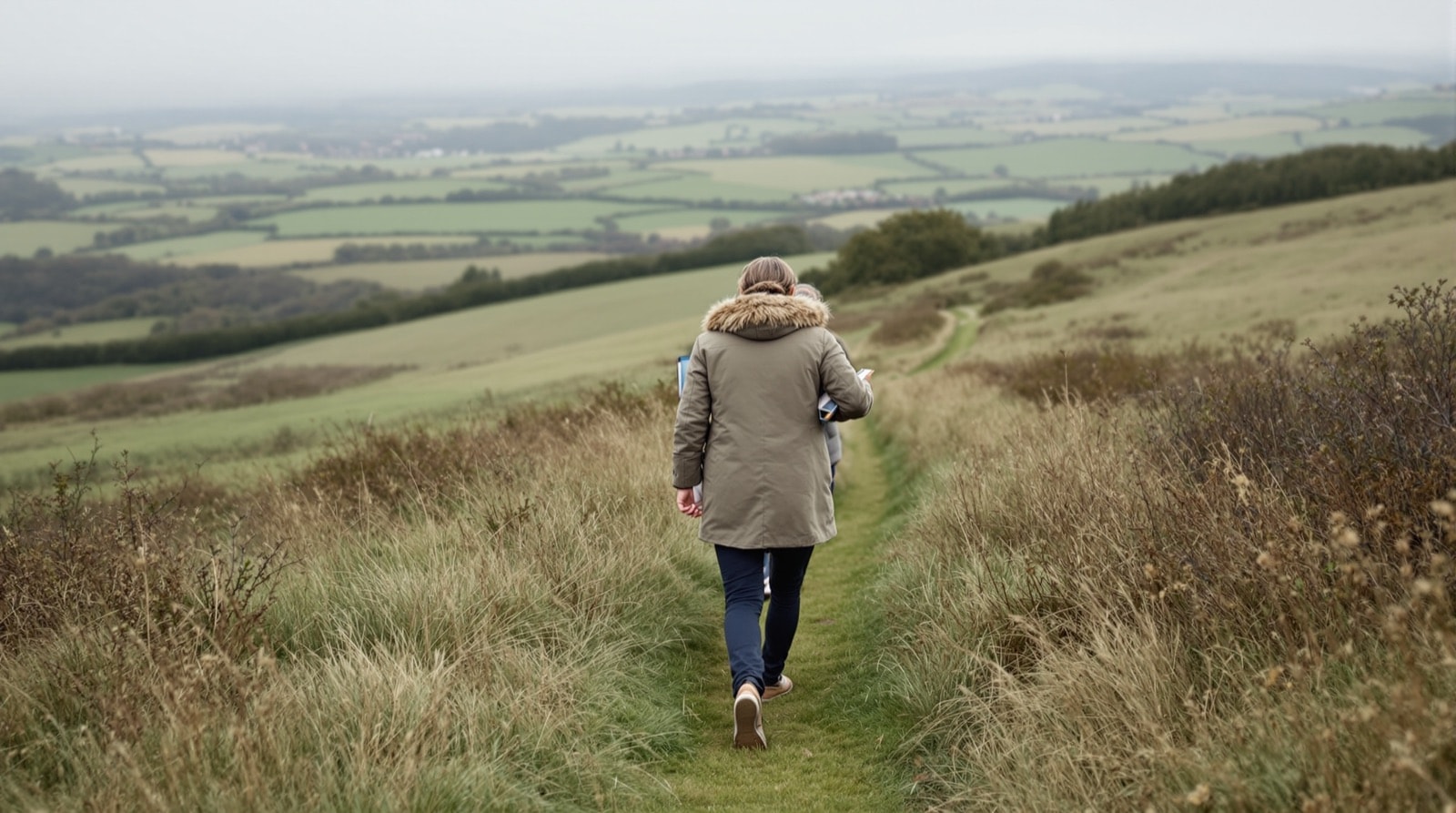
That is the whole of the definition. Everything else — the timings, the reshuffle mechanics, whether there is coffee at the end, whether dogs are welcome — is local variation, and the variation is wide.
What it is not
Three things get confused with netwalking often enough to be worth separating out.
- It is not a walking meeting. A walking meeting is an internal practice: two or three colleagues who already work together take an existing meeting outdoors. There is no networking element, because everyone already knows everyone. The overlap in technique is real but the purpose is different, and that variant is covered in walking meetings.
- It is not a group walk with a business theme. The distinguishing feature of a netwalk is that the conversational structure is deliberately managed — who walks with whom, and when that changes. A sociable ramble where people happen to work is a nice morning out, but it will not reliably produce the introductions that make people come back.
- It is not a fitness event. Pace is set by conversation, not by exertion. If participants are too out of breath to talk, the format has failed on its own terms. This is a point worth labouring, because the single most common design error is a route chosen for its scenery and gradient rather than for its talkability.
Where the format came from
Walking while discussing serious matters is not a modern invention, and it would be dishonest to present it as one. The Peripatetic school of philosophy took its name from the practice; treaties and business have been settled on foot for as long as both have existed. What is genuinely recent is the packaging of that instinct into a repeatable, scheduled, small-business networking format with an agreed structure.
That packaging emerged in earnest through the 2010s, and accelerated sharply in the early 2020s, for an obvious reason: a long period in which indoor gatherings were restricted left a lot of people who relied on face-to-face relationship-building with nowhere to do it. Outdoor formats absorbed that demand, and a meaningful proportion of them never went back indoors, because the participants preferred them. The format survived the circumstances that popularised it, which is the strongest available evidence that it is not simply a substitute.
The anatomy of the term
You will encounter several near-synonyms, and they are used loosely and interchangeably in practice:
- Netwalking — the most common single-word form.
- Walking networking or networking walk — the plainest descriptions, and the ones most likely to be understood by someone encountering the idea for the first time.
- Walk and talk — used both for netwalks and for internal walking meetings, which is exactly why it causes confusion.
- Business walk — occasionally used, usually for shorter urban formats.
There is no governing body, no accreditation and no standard definition. This is a practice, not an institution.
What a netwalk is good at
The format has a genuine speciality, and it is narrower and more useful than "networking". A netwalk is unusually good at:
- Depth over breadth. A ninety-minute walk with one reshuffle gives you two substantial conversations. A conventional networking morning might give you twelve shallow ones. For businesses sold through trust, two is often worth more than twelve.
- Removing performance. Without eye contact and without an audience, people describe their actual problems rather than their positioning. That is where useful introductions come from.
- Sustained thinking. The research on walking and idea generation, discussed in what the research shows, points to real gains in open-ended thinking. A walking conversation about "how might this work" outperforms the seated version.
- Attendance. People who avoid networking rooms will often come to a walk. The barrier that keeps them away is the room, not the networking.
What it is bad at
Equally, it should not be sold as universal. A netwalk is a poor format for anything requiring documents, screens, precise figures, minutes, or a decision that needs recording. It is a poor format for large numbers — beyond about twenty people a single walk becomes a procession and the reshuffle stops working. And it is a poor format if the route has been chosen badly, which is why route planning deserves more attention than it usually gets.
There is also a real inclusion question. A format built on walking three kilometres over a field excludes people, and it excludes them silently, because they simply do not book. Good organisers design around this rather than around the average attendee, and the approaches that work are set out in accessibility and pace.
The secondary benefit nobody planned
Netwalking is usually adopted for business reasons, but the health effect is not trivial. NHS guidance on the benefits of exercise is unambiguous that regular moderate activity carries substantial benefit, and a weekly or fortnightly hour of brisk walking that would otherwise have been an hour sitting down is a meaningful swap. Organisations such as The Ramblers have spent decades making the same argument about walking generally.
It is a genuine benefit and it is worth naming. It is not, however, the reason the format persists. The reason is that the conversations are better — which is the subject of why walking changes the conversation.